The night shift you never hire.
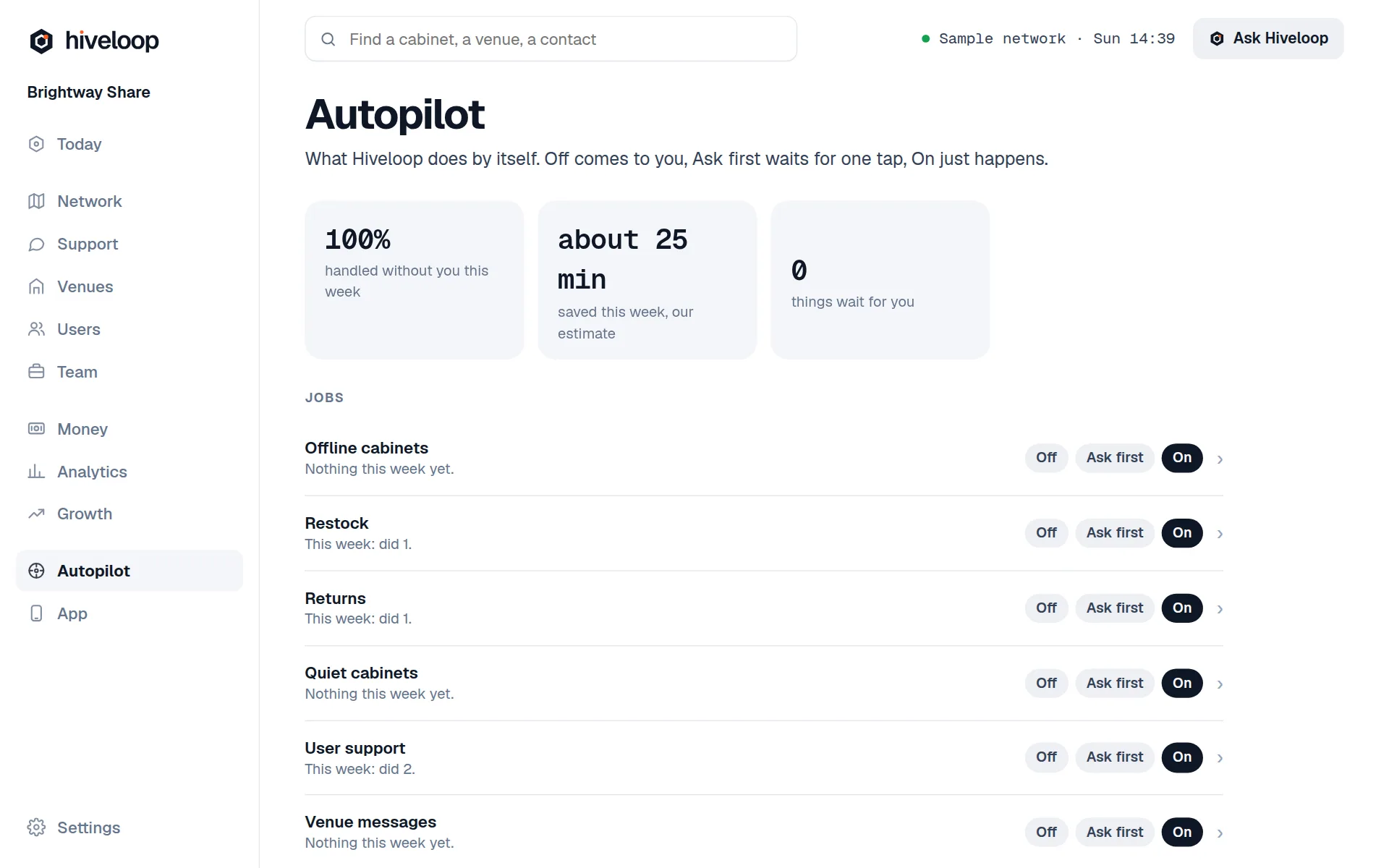
Most of running a network is the same twenty things, again and again. Autopilot does them, around the clock, by rules you can read out loud. What needs a decision comes to you as one card.
Last night on Autopilot
What it does
Six jobs, done all day.
Watches every cabinet
Every cabinet, payment and return, against its venue's opening hours. When something is off, it starts the fix itself and asks the venue first.
Answers every user
From your prices, hours and rules, in the user's language, within seconds. Hands over when it should.
Closes missed returns
A power bank the cabinet did not report is found in the next slot report and settled at the real return time.
Plans restocks
Cabinets running empty or full become stops on tomorrow's route, in the right order.
Drafts payouts
Venue shares, self-billing statements and the payout file, ready for your approval.
Finds the next move
The cabinet that earns least, the venue that would earn more, the hour you are sold out.
Rules, not forms
You write the policy. Autopilot follows it.
Every rule is one sentence. Change a value, switch a rule off, or add a limit. When a rule is off, its cases come to you instead. Nothing is hidden.
- Limits you set. Refunds, credits and goodwill up to your amount, above it your tap.
- Money waits for you. Payouts and refunds above your limit are never sent without approval.
- Every action logged, with the rule that made it and the facts it used.
If a cabinet is offline for while the venue is open, message the venue. Still offline after : add a repair stop.
Off. These cases now come to you, one card each.
A rental open longer than becomes a sale at the deposit, and the user is told.
Off. These cases now come to you, one card each.
Refund up to without asking me. Above that, ask me.
Off. These cases now come to you, one card each.
Quiet cabinets: a cabinet with no rental for in opening hours gets a check.
Off. These cases now come to you, one card each.
On the 1st, draft every venue's payout. Send after I approve.
Off. These cases now come to you, one card each.
Support, day and night
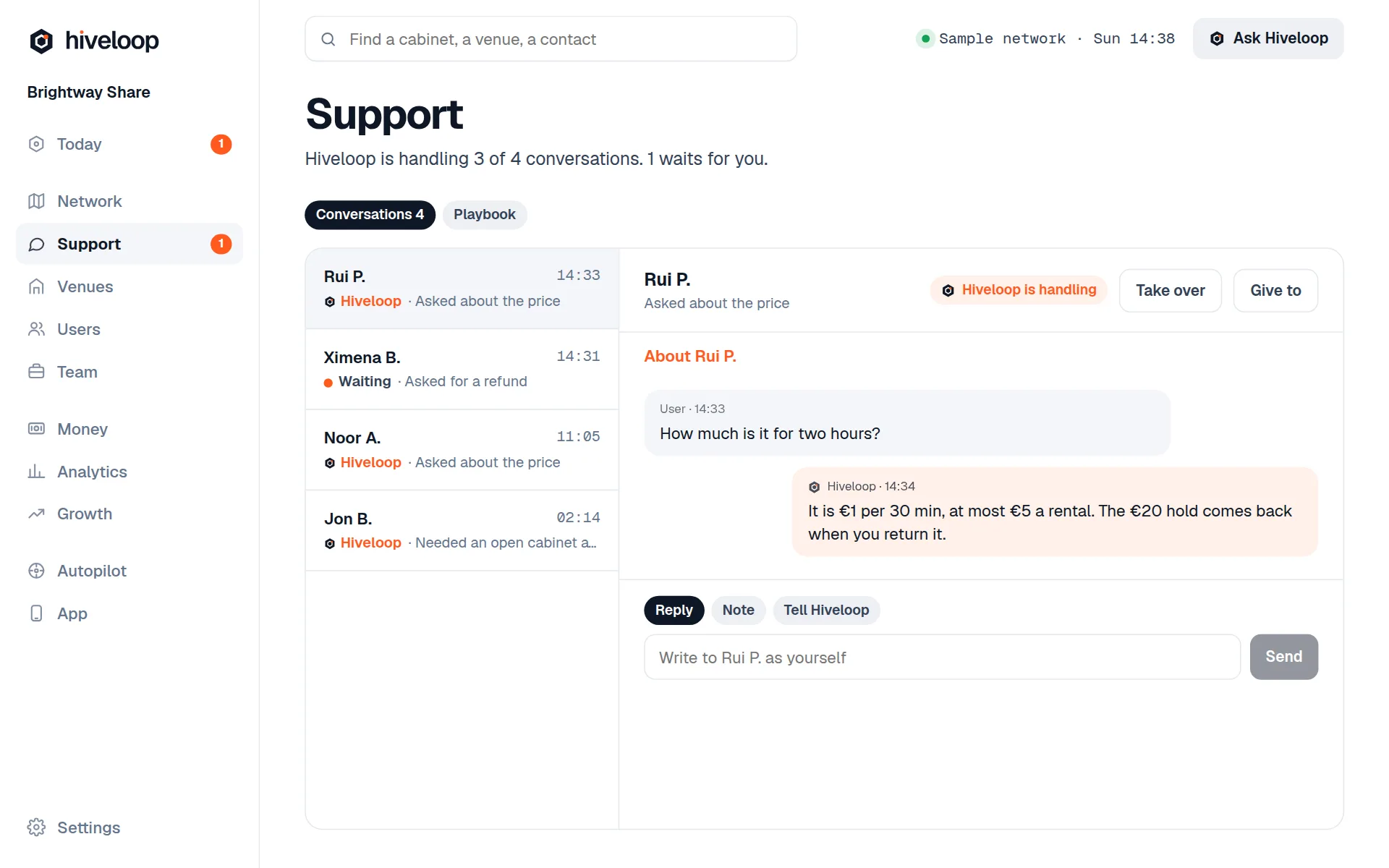
A user who is stuck gets an answer in seconds.
"The cabinet did not open." "I returned it but I was still charged." "Where can I return near the station?" Autopilot reads the rental, the cabinet's last report and your rules, and answers within seconds in the user's language. If it can fix it, it fixes it. If not, it tells the user what happens next and leaves you one card.
How the agents work
Running a power bank network with AI agents
The short version
- Agents handle support, monitoring, missed returns, restocks and payout drafts.
- Rules are sentences with values you set; each switches off on its own.
- Money above your limit and every payout wait for your tap.
- Every action is logged with the rule and the facts it used.
What work in a power bank network repeats every day?
Almost all of it. "Where can I return?" "It did not open." "I was charged twice." A cabinet offline at noon. A cabinet empty before the evening. A return the cabinet did not report. A payout run at the end of the month. None of this needs creativity. All of it needs to happen on time, day and night, and that is what agents are for.
What can AI agents do in a rental network today?
- Support: answer users in their language from your prices, hours and rules, using the rental's own record.
- Monitoring: judge every cabinet against its venue's opening hours, and ask the venue first.
- Missed returns: close them from the next slot report at the earliest provable time.
- Restocks: turn empty and full cabinets into tomorrow's route.
- Payouts: draft every venue's share and statement.
How is a return the cabinet missed settled?
From the slot report. A cabinet that was offline when a power bank went back in never sends the return message, so the rental would stay open and the user would keep paying. Autopilot sees the power bank appear in a slot at the next report and closes the rental at the earliest moment that can be proven, never later. The user is charged for nothing nobody can show.
Why one tap can never rent twice
Every rental runs behind a lock per user and cabinet, so a second request cannot start while the first is still running. A time window alone cannot tell a duplicate from a real second rental.
What agents never do alone
Refunds above your limit, payouts, contract changes and anything unusual come to you as one card with the facts and a proposed answer. The agent does the reading and the drafting; you decide in one tap.
How do you write rules for an agent?
As sentences with values you control. "Refund up to EUR 5 without asking me." "If a cabinet is offline for 20 minutes while the venue is open, message the venue." Each rule switches off on its own, and when a rule is off its cases come to you. Every action is logged with the rule that made it and the facts it used.